


The Murmansk Run – My Father’s War at Sea with the US Navy Armed Guard during World War II.
Of all the places my father visited during World War II, his favorite was Glasgow, Scotland. He remembered the kindness of Scottish families who welcomed American sailors into their homes, offering meals, conversation, and sometimes a place to spend the night. On one occasion, he even accompanied a family to church. Those moments of hospitality were a welcome contrast to life aboard the merchant ships on which he served as a member of the United States Navy Armed Guard.


My father, Robert Gerald Reed, enlisted in the Navy on November 11, 1942. After training at Sampson U S Naval Training Station, he was assigned to the Armed Guard, whose sailors manned defensive guns aboard merchant ships carrying fuel, food, ammunition, and other wartime supplies.
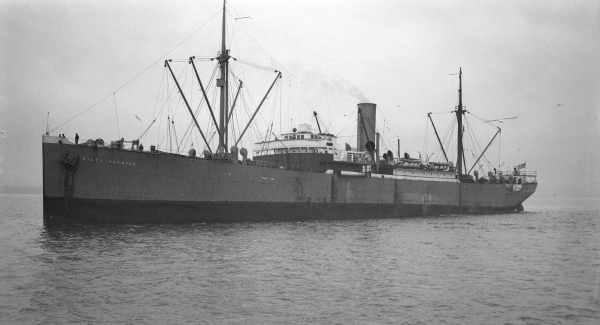
His first assignment was aboard the SS Steel Inventor, a cargo freighter built in 1920. In October 1943, he joined the Liberty ship SS Philip Livingston, which would take him on one of the most dangerous supply routes of the war: the Arctic convoys to northern Russia.

Illustrated schematic of the Allied Arctic convoy route from Scotland to Murmansk, 1943–44. The line represents the general route, not SS Philip Livingston’s exact course.
On December 12, 1943, Philip Livingston sailed with convoy JW-55A, a formation of 19 merchant ships protected by Allied naval escorts. The convoy reached northern Soviet ports on December 22. Among my father’s surviving papers is an identification certificate associated with Murmansk and dated that same day.

SS Philip Livingston, the Liberty ship aboard which Robert Reed served during the Arctic convoy voyages of 1943–1944.
Dad remembered the bitter Arctic cold, mountainous seas, and freezing spray that coated everything exposed to the weather. He stood watch at the forward gun position, where conditions sometimes became unbearable. “Even yourself, you know, the gun tub would be just covered with a mass of ice,” he recalled. Eventually, conditions became so severe that the men were taken off the exposed gun position and stood watch from the bridge. Food was another problem. Flour became infested with insects, eggs spoiled, and the men sometimes resorted to covering their meals with ketchup to make them edible.
Russia itself offered little relief. When asked years later what Russia was like, his answer was simply, “Bad.” He recalled going ashore with magazines to show some Russian girls they had met. Their visit was quickly interrupted by armed Russian soldiers, who confiscated the magazines and ordered the Americans back to their ship. There were also occasional enemy air raids. Dad remembered planes appearing overhead and dropping bombs near the harbor. “Every once in a while, a plane would come over and drop two bombs.”

In February 1944, Philip Livingston attempted to leave Russia with convoy RA-56, but the ship could not maintain the convoy’s required speed and was ordered back to port. Dad remembered the frustration of being unable to leave. “We stayed there for probably about six weeks, frozen in.” There wasn’t much to do except wait, exercise, stand watch, and play poker. Finally, on March 2, Philip Livingston sailed with convoy RA-57, reaching Scotland eight days later.
In his later recollections, Dad described witnessing merchant ships being torpedoed. One incident remained particularly vivid. “Saw the whole thing just erupt in flames, the whole thing just burned right up,” he recalled. He remembered destroyers racing between the ships, dropping depth charges that shook his own vessel. Another time, he watched sailors attempting to escape a sinking ship and recalled the helplessness of continuing on while men struggled in the water. Stopping could expose other ships to submarine attack. Although we have not established precisely which sinkings he witnessed, the memories remained with him decades afterward.
My father’s duties involved more than standing watch. In a surviving letter to Mary Washburn, dated June 13, although the year is missing, he described a day of gunnery practice. “We fired our guns today and didn’t do too bad. I’m more or less the trigger man on our gun and that’s what I like.” I find that little observation revealing. Despite the danger and discomfort, he apparently took considerable pride in his work.

Not all his wartime memories were frightening. In Glasgow, he recalled mothers and daughters welcoming visiting American sailors into their homes. Their sons were often away fighting the war themselves. Dad brought candy and silk stockings from America, gifts that were particularly appreciated during wartime shortages. He remembered those Scottish families with genuine affection, and their hospitality evidently meant a great deal to a young sailor far from home.
His Navy service continued after the Murmansk run. He served aboard the Liberty ship SS Walter Kidde and later the tanker SS Northfield. His travels took him to the Middle East, where he remembered working in Saudi Arabian oil fields, and into the Pacific, where his ship helped supply American warships.

SS Walter Kidde, a Liberty cargo ship built in 1944. Robert Reed served aboard from July 1944 to March 1945.
One surviving shipboard photograph shows Dad at the far left, posing with five other sailors and a large naval projectile. Their casual clothing suggests a much warmer setting than the Arctic winter, but neither the ship nor the date has been established. It is a welcome glimpse of the men he served alongside, away from the formal setting of a Navy portrait.

On August 12, 1945, writing to Mary from the region of Australia and the Indian Ocean, Dad reflected on news that Japan might finally surrender. “It makes most of us boys here feel pretty good. Infact very good to know that maybe the war will come to an end soon.” Two days later, Japan’s acceptance of the Allied surrender terms was announced.
Dad returned to the United States that autumn and was separated from the Navy on December 20, 1945, after more than three years of service. Many years later, my sister Bobbi Bolton recorded conversations with him about his Navy experiences. Those recordings, together with surviving letters, photographs, and Navy personnel records, have allowed me to reconstruct portions of his wartime service.
What strikes me most is how matter-of-factly he described experiences that would have terrified most of us. The bitter Arctic cold, the sinking ships, and the months away from home were simply part of the life he remembered. During one of those conversations, Bobbi wondered what it must have been like living aboard a ship under such conditions. Dad’s response was characteristically brief:
“You think about staying alive. That’s what you think about.”